
Why do we still design in silos?
Rain does not know that it has crossed a professional boundary. It falls on a roof that an architect designed, runs across a landscape design by a landscape architect, disappears into a pipe made by engineers, that belongs to a utility company, and ends up in a basin that a municipality maintains. Physically, this is one continuous system. Contractually, it is three or four separate projects, with three or four separate budgets, briefs and deadlines.
If everything is physically connected, why do we still design, finance and govern it in pieces? That question sits underneath almost every conversation about climate adaptation in cities right now, and it is the one I wanted to put on the table in this episode.
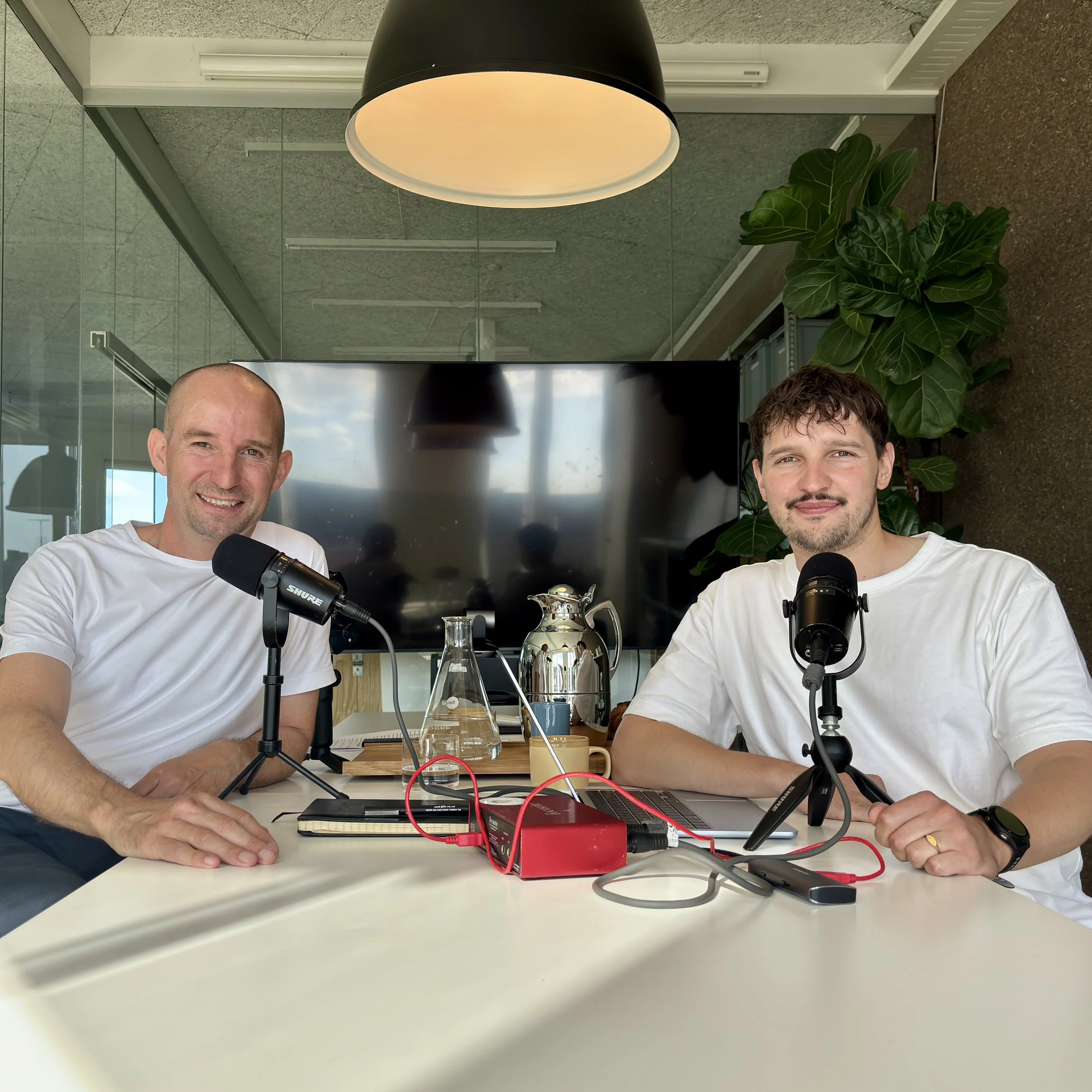
I talked about it with Tore Banke - architect, PhD, Head of Impact and Associate Partner at THIRD NATURE in Copenhagen, a practice working across architecture, landscape, climate adaptation and infrastructure. Tore came into the profession through computational design and spent more than fifteen years on the question of how data and technology can inform decisions early, when they still matter. Today his work sits where design meets engineering, financing and governance - which turns out to be exactly where the silos are.
A childhood wired to a windmill
Tore's interest in the space between technology and sustainability did not start at architecture school. It started at home. In 1980 his parents raised one of the first industrial wind turbines in Denmark - a small one by today's standards, wired directly into their own house, so the family could use the energy it produced. To read the output, you walked over and looked at a display on the machine itself. To actually steer it, you needed a computer, so the family bought one of the first PCs available in the early eighties and had someone write a piece of software for it.
It is a very small story with a very clear structure: a physical object, its data, and a tool to act on both. His parents later invested in the first offshore wind turbine in Europe and the third in the world. Long before renewables became a Danish export, Tore was standing next to people who treated green technology as a systems problem rather than a machine.
From complex shapes to better questions
He took his bachelor's degree in Aarhus, did his internship at COBE when the office was still about five people, and moved to Copenhagen partly because the school there had launched the first master's course in computational design. That was the era of generative components - software so heavy that only large international offices with specialist teams could realistically use it. Then, in 2007, Grasshopper arrived and the field opened up.
What is interesting is what did not attract him. The loud part of parametric design at the time was geometry: complex shapes generated from simple rules, form for the sake of form. Tore went the other way, towards performance. One of his first projects was a transformation of harbour silos in Fredericia, where a facade of roughly 5,000 panels was shaped by the programme behind it and by the daylight coming in. The aesthetics were a consequence, not a target. That line of thinking became his PhD, and its subject was timing as much as technology: "It's the early design decisions that have the most effect." Once the massing and the facade are fixed, changing them is expensive and usually does not happen.
The wider effect of these tools, in his account, was linguistic. Architects could suddenly speak more of the engineering language, engineers could push their data into the drawing set, and both could show a client what a decision would actually cost or save. The tool became a translation layer between very technical professions and the people paying for the result.
Enghaveparken: infrastructure you can sit on
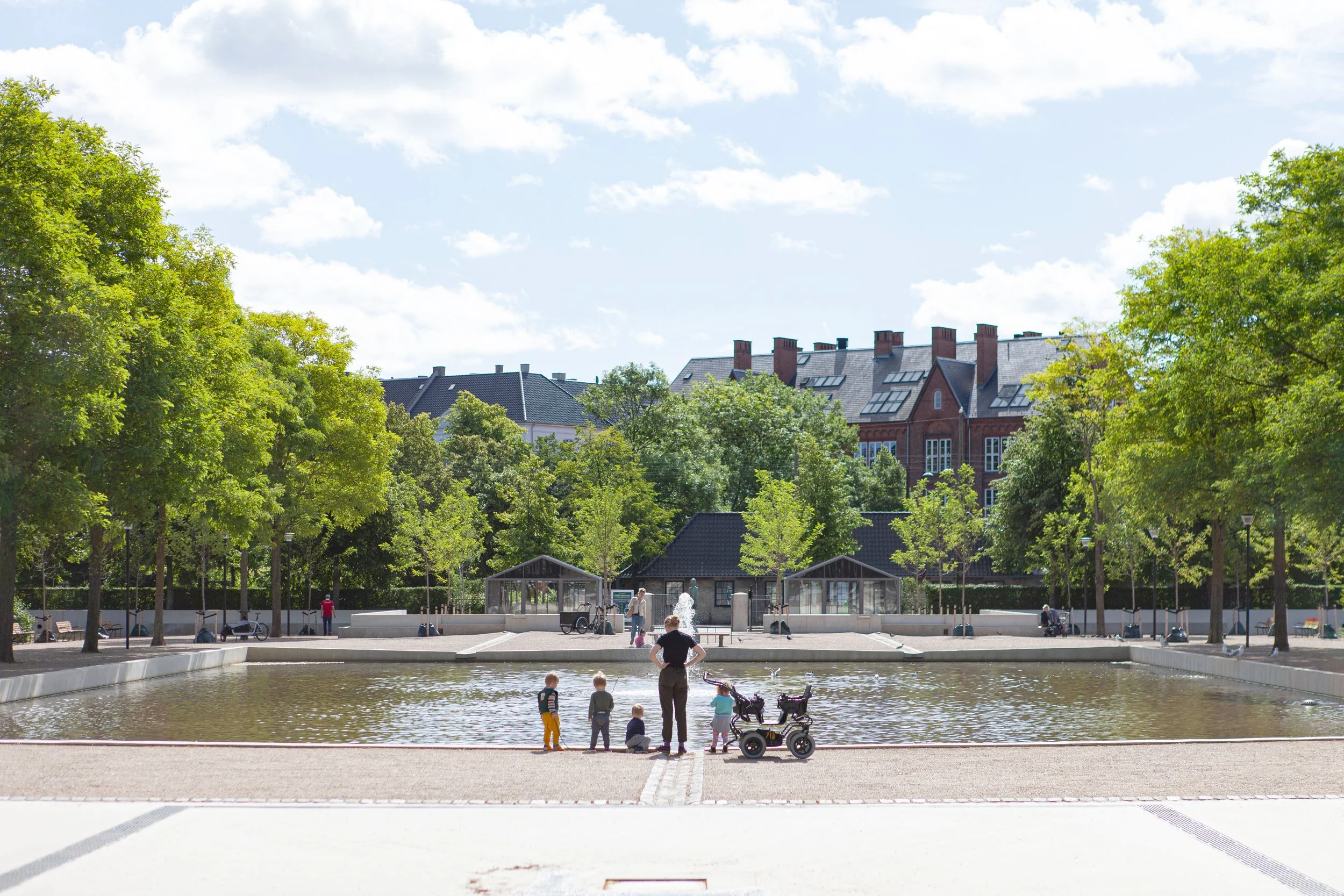
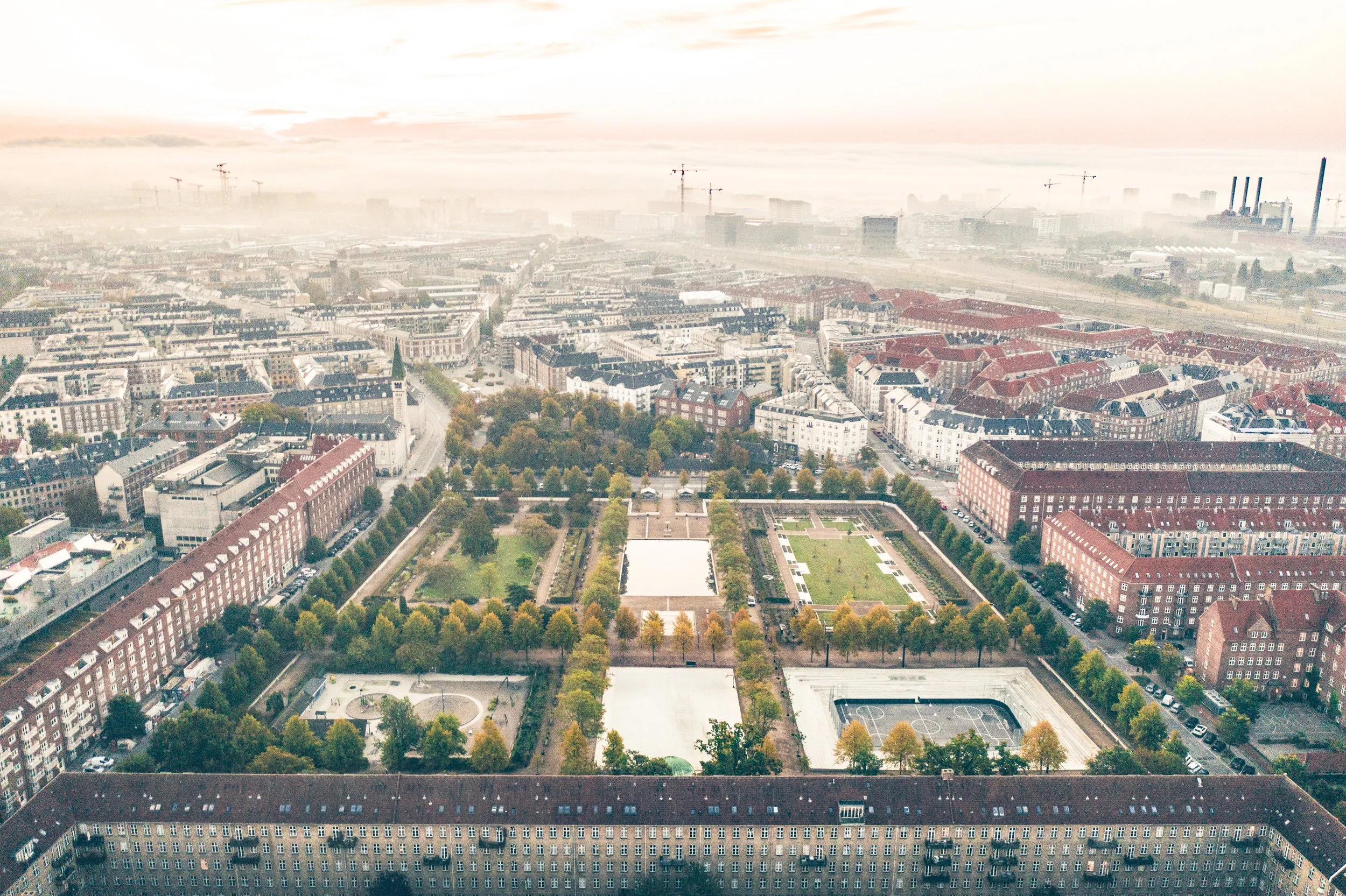
The clearest built example we discussed is Enghaveparken in Vesterbro, Copenhagen - a park roughly a hundred years old, redesigned between 2014 and 2019. To understand it, Tore says, you have to zoom out: the park is a component in a rainwater and cloudburst network, holding back water from the whole Carlsberg area so that it does not flood elsewhere.
The numbers are unusually concrete for a public space. The park handles everyday rain, ten-year events and hundred-year events, and can take up to 22,600 cubic metres of water in total - the entire site submerged to between 60 and 90 centimetres. A sunken multifunctional sports court fills first. A rainwater lake in the middle collects everyday rain, and the municipality received permission to reuse that water for irrigating trees in the neighbourhood, which matters more each year: we are not only getting wetter extremes, we are also getting longer dry seasons.
Two design details say a lot about the mindset. The dike running around the park is also a bench, and a teaching device - children put small boats in the channel and watch where the water goes. The gates that seal the park are hollow metal: when the water arrives, they rise by themselves, following Archimedes' principle. No motor, no sensor, no person who has to arrive in time. That solution came out of very early collaboration with the engineers at COWI, which is the point - it could not have been added later.
The design is solvable. The budgets are harder.
Enghaveparken was built in the political window opened by the 2011 cloudburst— around 150 millimetres of rain in a few hours, and roughly one billion Danish kroner of damage in a single event. That changed the will to invest. Many such projects were later paused, and the will is now returning.
My earlier podcast episode on the 2021 Copenhagen cloudburst:
What makes them possible, Tore argues, is not the drawing but the funding structure: Enghaveparken was financed close to fifty-fifty between the utility company and the municipality, with additional foundation money. Cities are increasingly fighting over the same square metres, so combining functions on one site is an obvious win for everyone involved. "What we are struggling with still is combining the budgets." The legal and political scaffolding for shared investment is the actual bottleneck - not the design imagination.
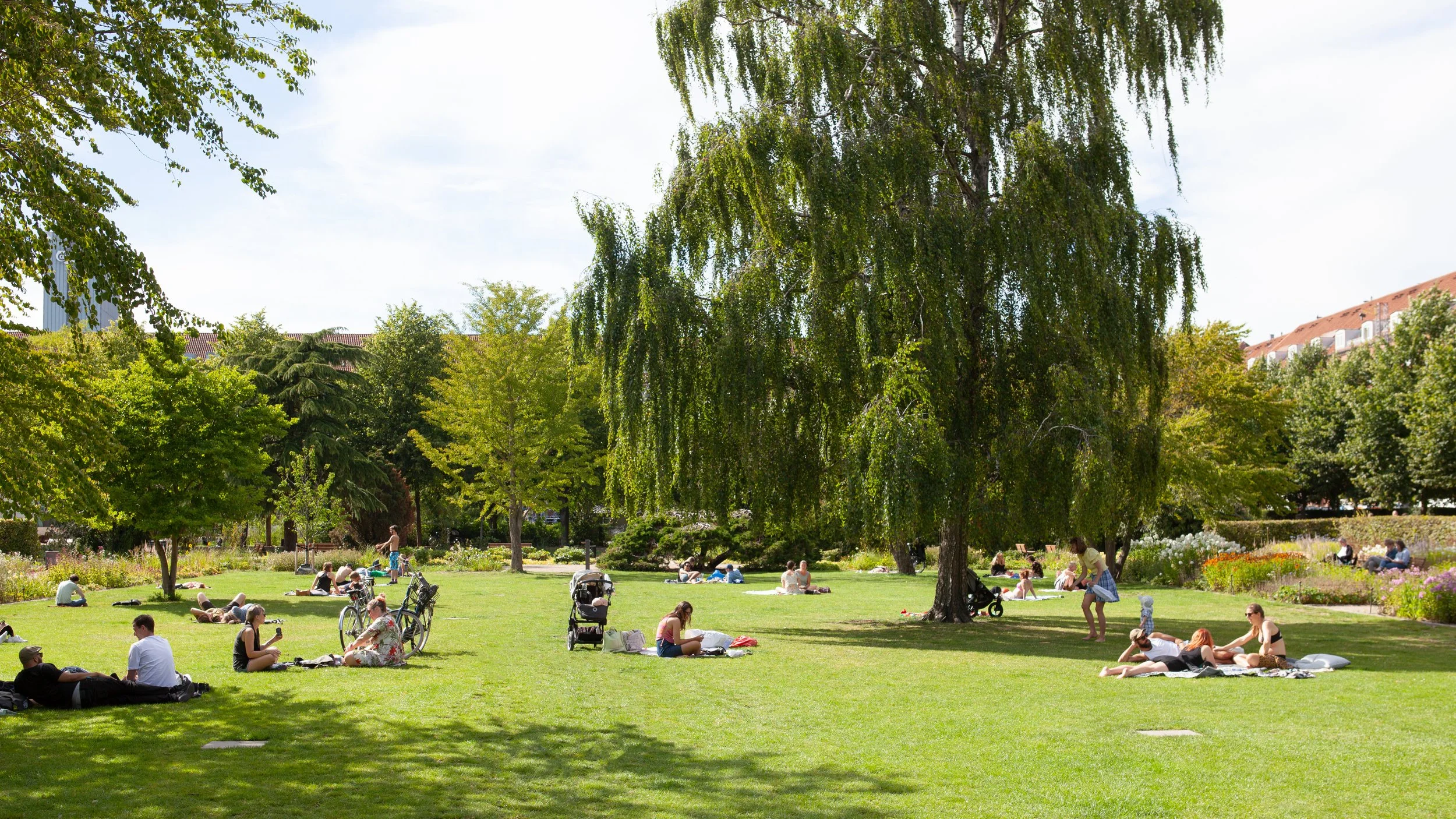
And the payoff is not only hydrological. For more than 99 percent of the time, this is simply a park that works, in a district that does not have many large green courtyards.
From one park to a method that travels
The question I always want answered is whether a good local project can become anything more than a good local project. Tore's answer is careful: not by copying. "It's not about copying solutions around, because every context is different." What travels is the method - a strategy, a way of reading a site, a set of adaptable components.
At THIRD NATURE, every project feeds what he calls a knowledge bank, so that arriving at a new site means arriving with tools rather than with a blank sheet. He described a national programme with a Danish mortgage credit institution, run as a parallel team with engineers from Rambøll, where the deliverable is precisely that: a method and a family of solutions to be adapted district by district across the country. It is, as he puts it, a computational idea applied to a process rather than to geometry.
Collaboration as design, not as coordination
Architecture is a competitive business, and Denmark is a small, saturated market with a lot of very good offices and only one winner per competition. So I asked whether the industry is genuinely collaborative or whether teaming is competition in nicer clothes.
Tore is straightforward about it. THIRD NATURE is a small office that ends up inside complex projects and complex organisations, which means it has to team constantly - sometimes for competences, often for the references a prequalification demands. Being small also means being selective, and being able to call the network when a client needs something the office is not the best at delivering. But the deeper argument is structural rather than commercial: "One project will not solve it all. You need to have the system thinking." If Enghaveparken sat in isolation from the network around it, it would simply not function. Water does not know any boundaries, so if you do not know where it comes from, where it has to go and when it has to leave, your solution is wrong regardless of how well it is drawn.
AI: democratised tools, undemocratised expertise
We could not end without the obligatory question on AI. He said that it feels like computational design twenty years ago. The technology is not fundamentally new; what changed is access. It has been democratised.
"Expert knowledge has not been democratised." You can now arrive very quickly at answers that look right and sound persuasive without being right - which means that knowing your subject matters more than it did before, not less. In the hands of people who do know it, he is unambiguous that the tools are extremely powerful, for the same reason computational design was: they bridge between specialists, collaborators and clients, and let a team hold more complexity at once.
His advice to architects worried about their jobs was not reassurance. It was to stay curious and find their own way through the shift, which is what people always have to do when the ground moves.
The point
The reason silos survive is not that anyone defends them. It is that budgets, mandates and procurement are still drawn along professional lines, while water, heat, energy and nature are not. Tore's closing thought was that the areas we now have to solve are simply too large for any single discipline or institution - and that the potential sitting in collaboration across them is correspondingly big.
Cities are one system that we insist on paying for in fragments. The next generation of infrastructure will be defined less by what we can design than by what we can afford to design together.
Full episode:
Reading recommendation
📘 The Gospel of the Eels — Patrik Svensson
