
Why is housing no longer just a social issue — but a political risk?
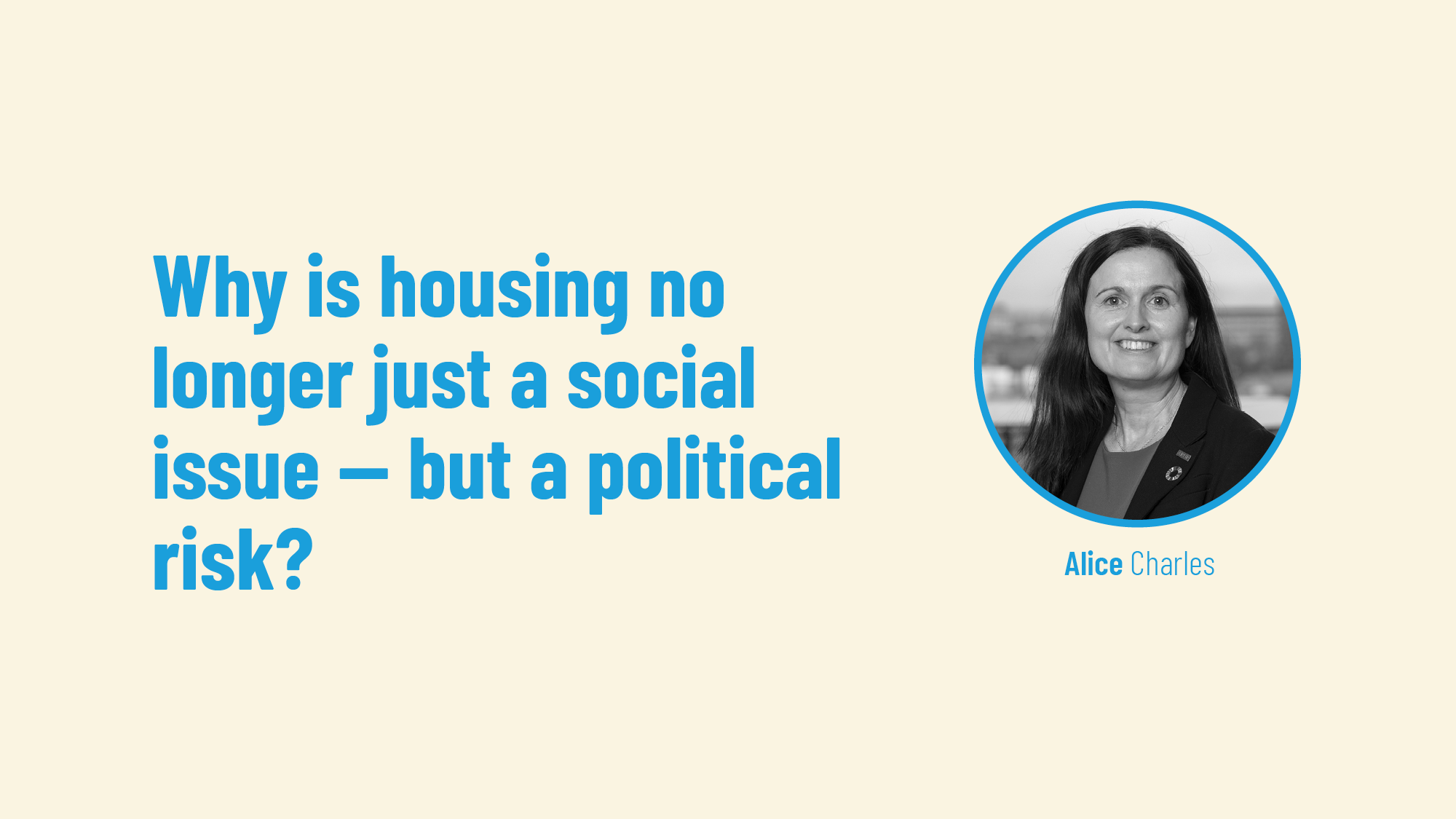
This time I talked with Alice Charles, Director of Cities, Planning and Design at Arup and former lead on cities and real estate at the World Economic Forum. As Alice said:
“Housing is no longer just a social issue — it’s becoming an economic and political risk.”
Luxury developments continue to rise across our cities. Skylines expand, cranes dominate the horizon, and new buildings promise growth, investment, and prosperity. And yet, despite this constant activity, the housing crisis only seems to deepen. For many, this contradiction feels inevitable — a side effect of urban success.
Housing is no longer just a question of supply and demand. It is becoming a structural issue — one that affects how cities function economically, socially, and politically. Understanding this shift is key to understanding why so many housing systems are failing today.
From market imbalance to systemic risk
For decades, housing policy has largely been framed through a relatively narrow lens. Build more, regulate better, improve affordability. While these tools remain important, they are no longer sufficient to describe the scale of the problem. Housing today sits at the intersection of multiple systems.
When people cannot afford to live in the cities where jobs are concentrated, labour markets become less efficient. When housing costs absorb a growing share of household income, consumption declines and inequality rises. When access to housing becomes uncertain, political pressure builds. In this sense, housing is no longer just a social issue, but a structural vulnerability.
This is why, as Alice points out, housing has increasingly appeared in conversations far beyond urban policy — from infrastructure finance to macroeconomic risk discussions at forums like Davos. The implications are clear: housing is not just shaping cities. It is shaping entire economies.
Building for capital, not for people
At the core of the problem lies a fundamental mismatch between what cities need and what the market delivers.
In theory, housing supply should respond to demand. In reality, it responds to financial viability. Developers, investors, and lenders operate within a system that prioritizes return on investment. And under current conditions — high construction costs, rising land prices, and global capital flows — that return is most easily achieved at the upper end of the market.
As a result, many cities are producing housing that does not match their actual demographic needs. Middle-income households, essential workers, and younger generations often find themselves priced out — not because housing is not being built, but because the type of housing being delivered is misaligned with their capacity to pay. This dynamic is not accidental, but systemic.
Without active public involvement, the private sector alone cannot be expected to deliver housing across all income levels. The incentives simply do not support it.

The overlooked role of public land
One of the observations in the conversation is how often cities underestimate their own influence. Public authorities are not just regulators of the housing market. In many cases, they are its largest landowners. This creates a significant — and often underutilized — opportunity.
Cities that strategically manage public land can shape development outcomes in ways that go far beyond zoning or regulation. They can influence where housing is built, what type of housing is delivered, and how value is captured and reinvested.
Yet too often, public land is treated as a financial reserve to be liquidated in times of fiscal pressure. Selling assets may provide short-term relief, but it undermines long-term capacity to shape urban development. There are alternative approaches.
Copenhagen, frequently cited as a leading example, has demonstrated how public land can be leveraged to finance infrastructure, support regeneration, and deliver housing in a coordinated way. By pooling assets and creating governance structures that operate beyond electoral cycles, the city has been able to align long-term development with public goals.
This model is called the Copenhagen Model, or the City & Port authority. There is a fantastic study on this topic: https://www.brookings.edu/articles/copenhagen-port-development/
The limits of short-term thinking
At the heart of the housing challenge lies a deeper tension between time horizons. As Alice said:
“Politics is short term. Infrastructure is long term.”
This simple observation captures one of the most fundamental constraints in urban development. Housing, like infrastructure, requires long-term planning. Projects unfold over years, often decades. They depend on stable policies, consistent investment, and coordinated decision-making.
But political systems operate on much shorter cycles. Elections, shifting priorities, and changing leadership make it difficult to sustain long-term strategies. This misalignment has real consequences.
Policies are introduced, adjusted, and sometimes reversed before their effects can fully materialize. Large-scale projects stall or change direction. And the continuity required for effective housing delivery is lost. The result is not just inefficiency — it is fragmentation. Without mechanisms that protect long-term planning from short-term political pressures, even well-designed housing strategies struggle to deliver consistent results.

Copenhagen - one of the most livable cities (also with its own housing problems)
Different systems, different outcomes
Housing systems are not uniform, even within Europe. In some countries, homeownership is deeply embedded in both policy and culture. Owning a home is seen not only as a personal goal, but as a primary means of financial security. In others, long-term renting plays a much more significant role.
Switzerland offers an interesting case. A large share of the population rents, often for extended periods, within a system that provides stability and predictability. Strong pension structures reduce the need to rely on property as a store of wealth, allowing housing to function more as a service than as an investment. This creates a fundamentally different dynamic.
Where ownership dominates, housing markets tend to become more volatile and more closely tied to financial cycles. Poland (where I am from) is unfortunately, a particularly bad example - the ownership rate here is from 84% to 87%. Where renting is stable and institutionalized, pressure on prices and speculation can be reduced. These differences matter because they shape not only housing outcomes, but broader social expectations.
There is no single model that fits all contexts. But understanding these variations helps explain why some systems are more resilient than others.
The hidden capacity within existing cities
Another important dimension of the housing crisis is often overlooked: the underuse of existing assets. Even in cities experiencing acute housing shortages, there are vacant units, unused buildings, and underutilized spaces. This is sometimes referred to as the “vacancy paradox.”
Addressing it requires more than simply building new housing. It requires understanding why existing assets are not being used. In some cases, regulatory barriers — such as safety standards or conversion requirements — make it difficult to repurpose buildings. In others, financial incentives encourage owners to hold properties vacant in anticipation of future value increases.
Cities that have begun to tackle this issue often start with data. By analyzing energy consumption or water usage, they can identify patterns of vacancy and target interventions more effectively. Unlocking these assets will not solve the housing crisis on its own. But it represents a critical piece of the broader puzzle.
A different role for cities
What emerges from our conversation is a shift in how we should think about the role of cities themselves. Cities are not just arenas where housing markets operate. They are active participants in shaping those markets. This requires a more strategic approach.
In the short term, cities need to make better use of what already exists — bringing vacant and underutilized assets back into the system. In the medium term, they need to improve the efficiency of planning processes and enable more flexible forms of development. And in the long term, they must invest in unlocking complex regeneration sites that will define future supply.
But beyond specific policies, there is a broader shift required. Cities need to move from reactive governance to proactive stewardship. They need to think not only about regulating development, but about shaping it. And they need to align their tools — land, infrastructure, finance, and policy — around long-term objectives.
Because ultimately, housing is not just about buildings. It is about who gets to live in the city, how cities grow, and whether they remain inclusive places — or become increasingly divided. The housing crisis is not inevitable. But addressing it requires acknowledging that it is not just a market failure. It is a system failure - and systems can be redesigned.
Reading recommendation:
The New Geography of Innovation - Mehran Gul
